


Aramoana paving begins in Bridge Street
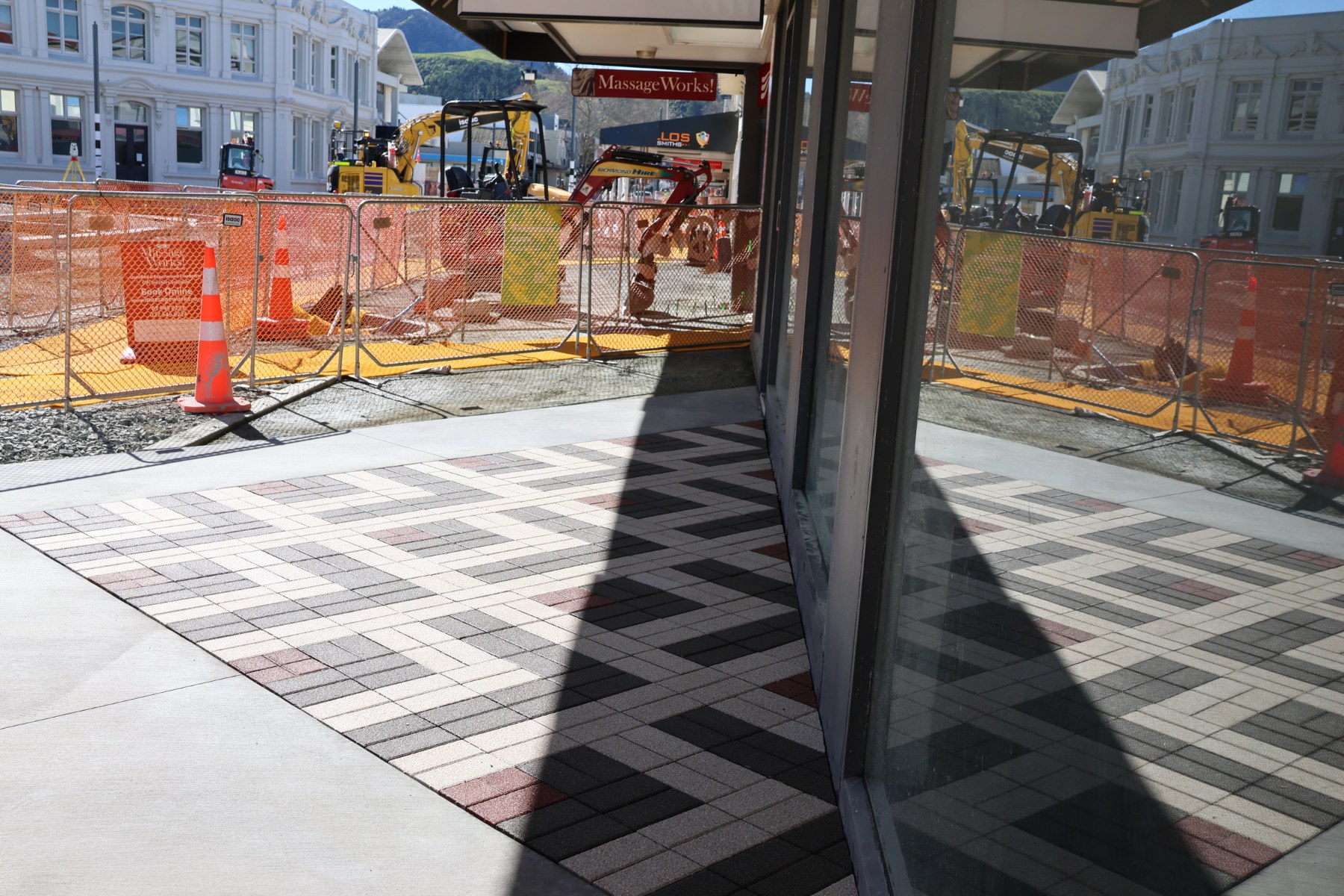
Bridge Street’s new streetscape is starting to take shape, with work underway to lay the first of 15 aramoana paving nodes planned along the street as part of the Bridge to Better project.
The first have been installed at the Rutherford Street end of Bridge Street, beginning a surface design that will feature throughout the street.
Aramoana means “pathway to the sea”. Its distinctive zig-zag form speaks to the natural patterns created through Tai Timu, Tai Pari – the ebb and flow of the tide. The pattern forms part of an overarching design that traces a pathway from Te Ngāhere (The Wood) at the eastern end of the street to Te Paruparu (Nelson Haven) in the west.
Bridge to Better iwi co-design lead Johny O’Donnell says the aramoana reconnects the street with its coastal story, shaping everything from the overall spatial layout to finer details.
“Before this project, you could walk along Bridge Street with little sense that this was once an estuarine environment. We’re bringing that coastal identity back into the streetscape.”
“Everything that has been done throughout the street has been this really deliberate process of trying to remember and reconnect with our coastal identity as a city.”
Within each of the triangular nodes that make up the aramoana pattern, pavers are arranged to form raranga (weaving) patterns, designed by local weaver Hamuera Manihera.
Hamuera says the two patterns draw on the Tai Timu, Tai Pari narrative, reflecting the changing landscape from the estuary to the forest.
At the western Rutherford Street end, the Tai Timu pattern draws from the estuarine environment, referencing pātiki and ngā manu moana – flounder and seabirds associated with the shallow waters and outgoing tide.
Further east, the Taipari pattern reflects the whenua and ideas of abundance and growth, with references to kūmara tipu (growing kūmara), ngā manu (birds) and ngā maunga (mountains).
“It’s exciting to see our cultural identity becoming part of everyday life in the city. For a long time, we haven’t had a presence in the city centre, so it means a lot to see it taking shape," Hamuera says.
Kōwhaiwhai designed by toi Māori artist Fayne Robinson will be vapour-blasted into concrete bands framing the rāranga paving. The patterns were developed in response to the Tai Timu, Tai Pari narrative, reflecting the movement and flow of water.
The rāranga designs are laid using Waipave, a permeable paver that allows rainwater to pass through the surface. Together with the introduction of rain gardens along Bridge Street, these areas will help absorb and filter stormwater before it enters the stormwater system.
Johny says the project has looked for ways to bring cultural expression and practical benefits together.
“We’re making the design work harder for the city - creating a better place for people, strengthening our green infrastructure and reflecting our unique cultural identity.”
“These paving areas will add colour, texture and character to the street. That makes it a more inviting place to spend time, with an identity people can recognise as distinctly Whakatū.”
As more of the paving zones are laid, the wider aramoana pattern will become increasingly visible along Bridge Street.
“The aramoana has been deliberately applied at different scales, connecting the spatial layout with the smaller details you experience up close. Everything feels like it belongs together.”
