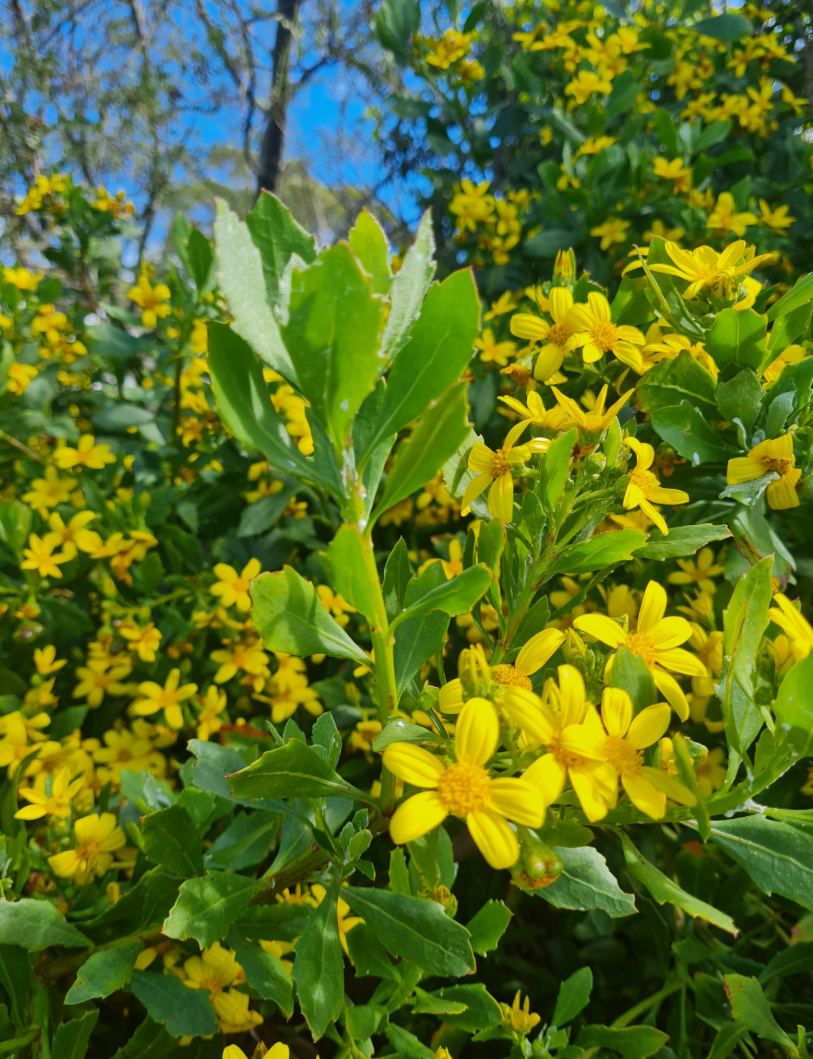
This spring and summer, residents in Stepneyville, Moana, Washington Valley and Britannia Heights can help stop this coastal pest plant from spreading.
Boneseed (Chrysanthemoides monilifera) is an introduced evergreen shrub and a serious coastal pest plant. After years of control, it has almost been eradicated from the Nelson–Tasman region. The only place where it remains common is in Nelson’s Port Hills suburbs of Stepneyville, Moana, Toi toi, Washington Valley and Britannia Heights.
This spring and summer, Council is increasing awareness in these neighbourhoods so remaining plants can be found and controlled. Reports from residents will help Council get on top of the infestation and reduce the risk of boneseed reinvading the wider region. If you have it on your property, let us know and we will come and control it for you.
Why is boneseed a problem?
Boneseed has its biggest impact in coastal places such as cliffs, dunes, saltmarshes and open scrub. It can form dense stands that displace desirable native plants. It also produces abundant seed that can remain dormant when deeply buried for more than 10 years, so missed plants can create problems well into the future.
How to identify boneseed
Boneseed is flowering now and is easy to see. Because several other plants have similar yellow flowers, please send Council a photo and location so the sighting can be confirmed.
- Flowers: small, bright yellow, daisy-like flowers, usually at the ends of branches.
- Growth: a dense, multi-branched shrub 1-3 metres high.
- Leaves: Leaves: distinctively upright, thick, leathery, with irregularly toothed edges
More pictures and information here: https://www.weedbusters.org.nz/all-about-weeds/weed-list/boneseed/
Seen it? Report it to Council
If you think you have found boneseed - please report it. Note the exact location and, if it is safe, take clear photographs of the whole plant, leaves, and flowers. Email biosecurity@ncc.govt.nz or phone 03 546 0200. Please do not transport seeds or plant material, as this could spread the pest.